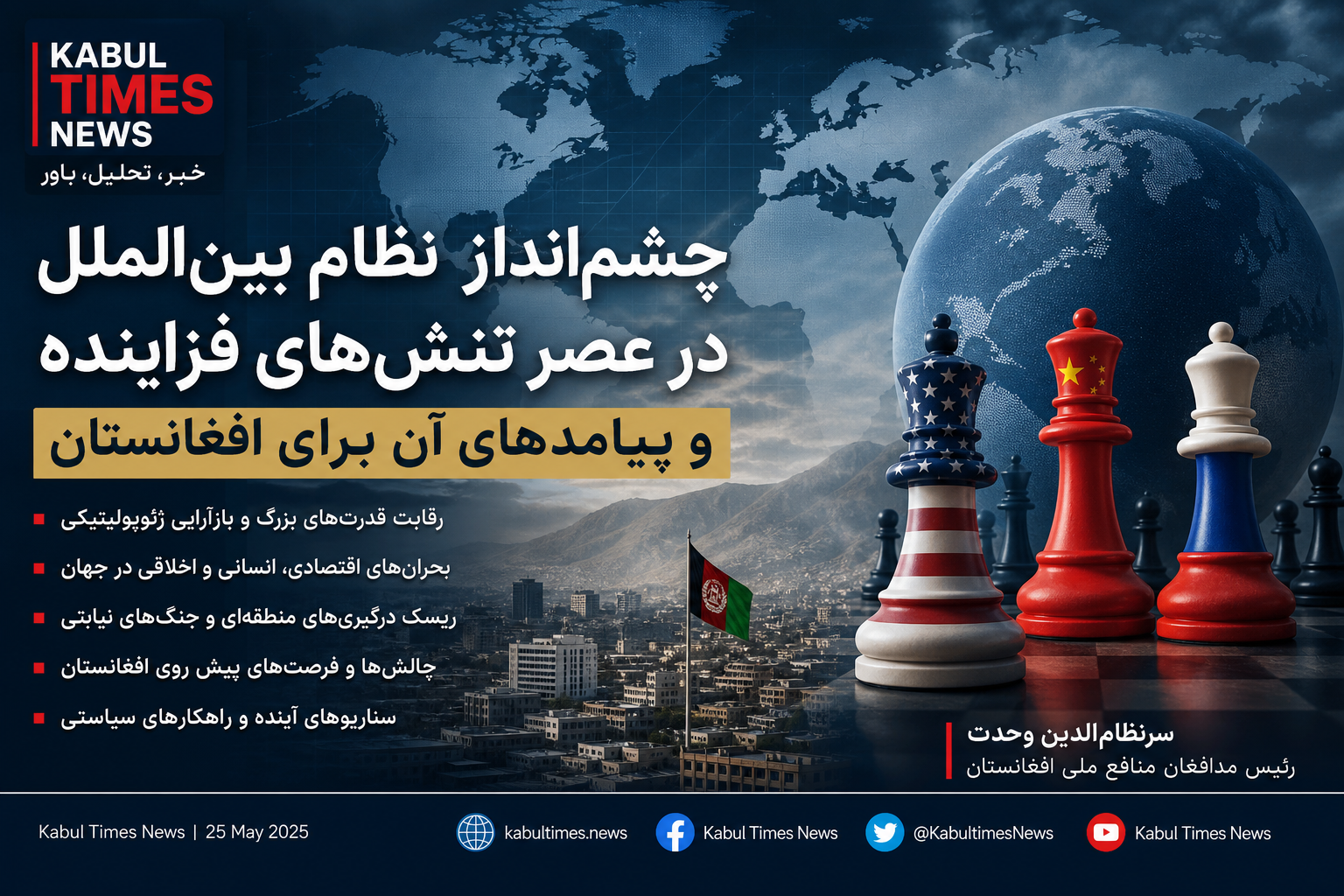
Reconfiguring the International System and Its Strategic Implications for Afghanistan
A Policy Brief for Decision-Makers
Kabul Times News | Special Strategic Report
2026-05-05
The international system is undergoing a profound structural transition from the post-World War II liberal order to an asymmetric and fluid multipolar model. This transition has been accompanied by increased geopolitical competition, the weakening of multilateral institutions, the intensification of economic crises, and the spread of emerging threats.
For Afghanistan, these developments simultaneously carry significant risks and limited but meaningful opportunities. In the absence of a coherent national strategy, the likelihood of structural vulnerabilities intensifying will be high. In contrast, adopting a balanced, pragmatic, and multi-layered policy can pave the way for exploiting some of the opportunities arising from regional competition.
1. The nature of the transition in the international system
Current developments indicate a “systematic reconfiguration” of the global power structure. Key features of this transition include:
- Asymmetric multipolarity: distribution of power among multiple actors without a stable balance
- Increasing strategic uncertainty: reduced predictability of power behavior
- Weakening multilateralism: reduced effectiveness of international institutions
- Normative divergence: increasing disagreement over global rules and values
2. Main drivers of global instability
2.1 Great power competition
The competition between the United States, China, and Russia has become the main axis of the dynamics of the international system, leading to a realignment of alliances and increased geopolitical tensions.
2.2 Global economic fragility
Structural inflation, rising debt, and economic inequality have reduced the capacity of governments to manage crises and have created the basis for social discontent.
2.3 Technological and Security Developments
The proliferation of emerging technologies—including artificial intelligence, cyberwarfare, and cognitive operations—has made the nature of threats complex and multifaceted.
2.4 Climate Change and Resources
Climate change, as a “crisis multiplier,” has led to increased migration, competition for resources, and instability in fragile regions.
3. Systemic Risks in the Emerging Order
- Increased regional conflicts and proxy wars
- Persistent chronic instability in vulnerable states
- Weakening human rights regimes and international norms
- Widening global trust gaps
4. Strategic Implications for Afghanistan
Afghanistan faces a dual situation in this transition:
4.1 Risks
- Geopolitical isolation: limited diplomatic and economic engagements
- Economic vulnerability: high dependence on foreign aid
- Proxy competition risk: possibility of becoming a competition arena for regional powers
- Human challenges: continued poverty, unemployment, and migration
4.2 Opportunities
- Possibility of exploiting regional competition to attract cooperation
- Capacity to play a role as a regional bridge
- Opportunity to redefine foreign policy based on balancing
5. Possible scenarios (2026–2030)
Scenario 1: Continuation of the static situation
- Relative stability without structural progress; continued dependence and fragility.
Scenario 2: Intensification of instability
- Increase in regional tensions and their spillover into Afghanistan.
Scenario 3: Gradual Restabilization
Movement towards stability through domestic reforms and targeted external engagement.
6. Policy Recommendations
6.1 In the field of foreign policy
- Adopt an active balancing approach between regional and global powers
- Diversify diplomatic and economic partners
- Strengthen multilateral and regional diplomacy
6.2 In the field of domestic governance
- Strengthen state institutions and increase the efficiency of governance
- Improve transparency and accountability
- Focus on social stability and national cohesion
6.3 In the economic field
- Reduce dependence on foreign aid through the development of domestic resources
- Attract regional investment in infrastructure sectors
- Develop local economies and create jobs
6.4 In the security field
- Manage asymmetric threats and prevent the influence of proxy actors
- Strengthen regional security cooperation
- Focus on domestic stability as a prerequisite for development
7. Strategic Summary
The transition of the international system to a new order is a complex and long-term process, the consequences of which will be distributed asymmetrically. For Afghanistan, this transition is both a “structural challenge” and a “potential opportunity.”
Success in this environment will depend on the country’s ability to redefine its national strategy, strengthen institutional capacities, and adopt a smart and multi-layered foreign policy. In the absence of such an approach, the risk of geopolitical marginalization and the continuation of the stalemate will increase.
Author: Sarnezamuddin Wahdat
Head of the Defenders of the National Interests of Afghanistan
Reconfiguring the International System and Its Strategic Implications for Afghanistan