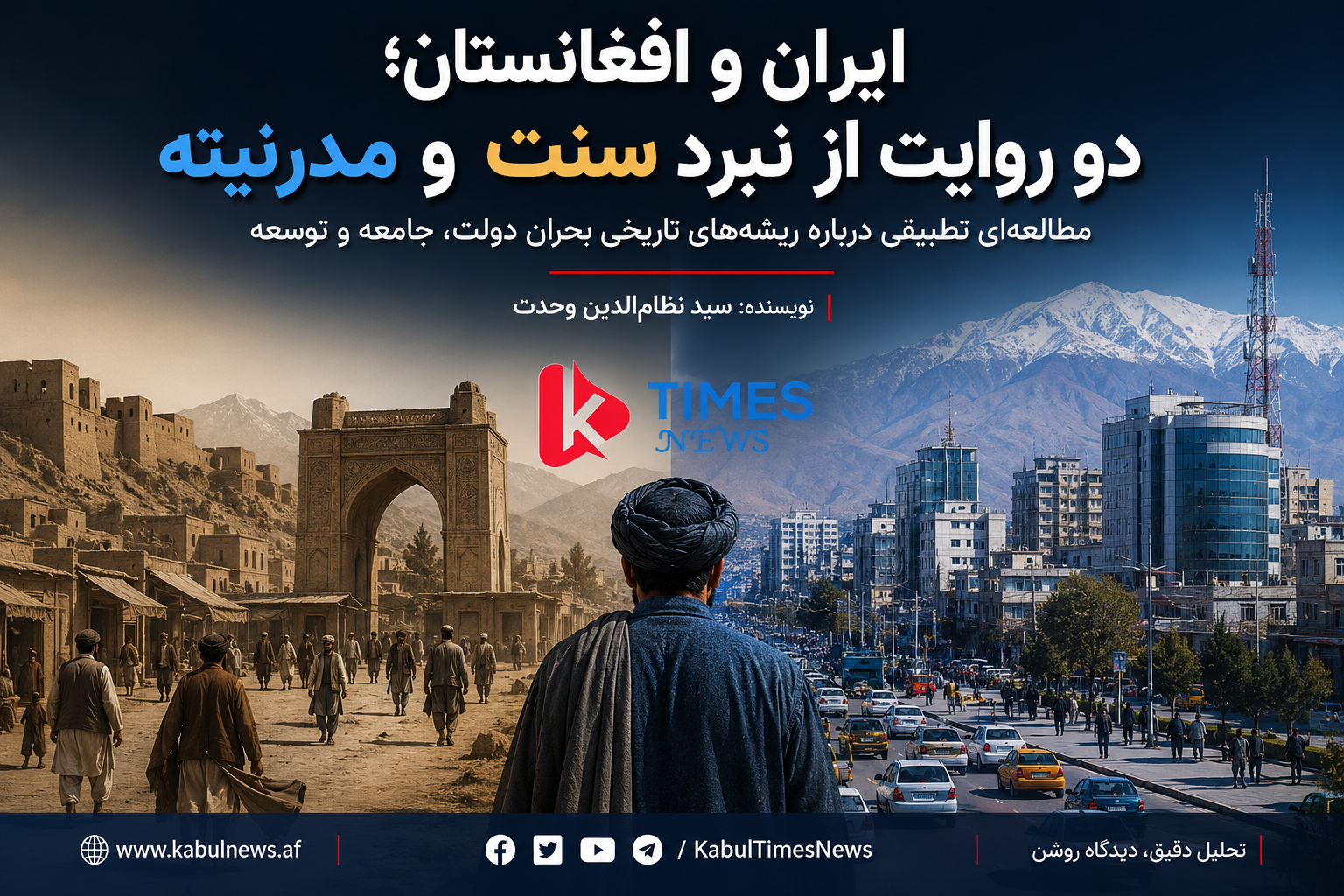
Iran and Afghanistan; Two Narratives of the Battle of Tradition and Modernity
A Comparative Study on the Historical Roots of the Crisis of State, Society, and Development
Author: Sayed Nizamuddin Wahdat
Master of Political Sociology and Head of the Defenders of the National Interests of Afghanistan
Abstract
Iran and Afghanistan, two neighboring countries with deep historical, cultural, and linguistic ties, have taken different but similar paths in confronting modernity over the past century. Since the beginning of the twentieth century, both countries have embarked on the process of modern state-building, administrative reforms, the development of modern education, and the modernization of social structures; but this process in both societies has been met with resistance from traditional forces, the weakness of government institutions, political rivalries, and foreign interventions.
This article argues that the current crises in Iran and Afghanistan cannot be reduced simply to the confrontation between tradition and modernity or religion and modernity; Rather, these crises are the product of the interaction of a set of historical, political, social, and international factors that have influenced the process of state-building and development over decades.
Introduction
Iran and Afghanistan are the heirs of a common civilizational sphere that has been shaped for centuries on the basis of the Persian language, Iranian-Islamic culture, trade, literature, and thought. With the beginning of the twentieth century, both countries entered the stage of modern state-building almost simultaneously.
In Iran, the Constitutional Revolution, Reza Shah’s reforms, the Islamic Revolution of 1979, and the developments that followed marked different stages of this historical conflict. In Afghanistan, Amanullah Khan’s reforms, political coups, Soviet occupation, civil wars, Taliban rule, and the developments after 2021 shaped a similar process but with their own characteristics.
Tradition and Modernity; Two Concepts Beyond a Simple Duality
In the social sciences, tradition is not necessarily synonymous with backwardness, and modernity is not considered to mean absolute Westernization.
Tradition includes a set of values, religious beliefs, social structures, religious institutions, and cultural patterns that have been shaped over centuries. In contrast, modernity encompasses a set of institutions and values such as the rule of law, public education, the university, civil rights, science, the modern economy, free media, and political participation.
A crisis occurs when these two value systems are confronted without social preparation and without constructive dialogue.
Iran: The Experience of Modernization from Above
Iran’s contemporary history shows that the government has tried to lead the modernization process from above at various times. A significant part of the reforms in the fields of education, the army, the administrative system, and economic development were initiated by the government, not from within society.
As a result, a part of society viewed these reforms as a threat to its cultural and religious identity. In response, traditional forces mobilized to maintain their social and political position, and this confrontation ultimately became one of the grounds for the formation of the 1979 Revolution.
Afghanistan; Modernity That Didn't Get a Chance to Be Institutionalized
Afghanistan also embarked on the path of reform almost simultaneously with Iran. Amanullah Khan tried to lead the country towards modernization through the development of education, administrative reforms, legislation, and the reduction of the influence of traditional structures.
However, the tribal structure of society, the weakness of government institutions, and the lack of social consensus caused these reforms to encounter widespread resistance. Later, coups, the Cold War, the Soviet occupation, civil wars, and foreign interventions deprived Afghanistan of the opportunity to form sustainable institutions.
Historical Similarities of the Two Countries
Iran and Afghanistan share common experiences in several fundamental areas:
- Possession of a common civilizational and cultural heritage
- The prominent role of religion in social identity
- The almost simultaneous beginning of reform and modernization projects
- Resistance of some traditional forces to rapid changes
- The influence of foreign powers on the process of internal developments
- The gap between the state and parts of society
Fundamental Differences
Despite the similarities, there are also important differences between the two countries.
Iran has had a more stable central government, a larger economy, more extensive urbanization, and older administrative institutions. In contrast, Afghanistan has faced widespread ethnic diversity, difficult geography, powerful tribal structures, and decades of war and foreign intervention.
These same factors have made the process of state-building and institution-building in Afghanistan much more fragile than in Iran.
Is the problem simply tradition?
The answer to this question is no.
New research shows that other factors also play a decisive role in the formation of the development crisis, including:
- Weakness of government institutions
- Administrative corruption
- Poverty and economic inequality
- Prolonged wars
- Foreign interventions
- Unproductive economy
- Lack of national consensus
- Authoritarian implementation of reforms
Therefore, tradition is only one variable in this complex equation and it cannot be held responsible for all the existing crises.
Conclusion
The historical experience of Iran and Afghanistan shows that no society achieves sustainable development simply by eliminating tradition or simply by rejecting modernity.
Iran and Afghanistan; Two Narratives of the Battle of Tradition and Modernity