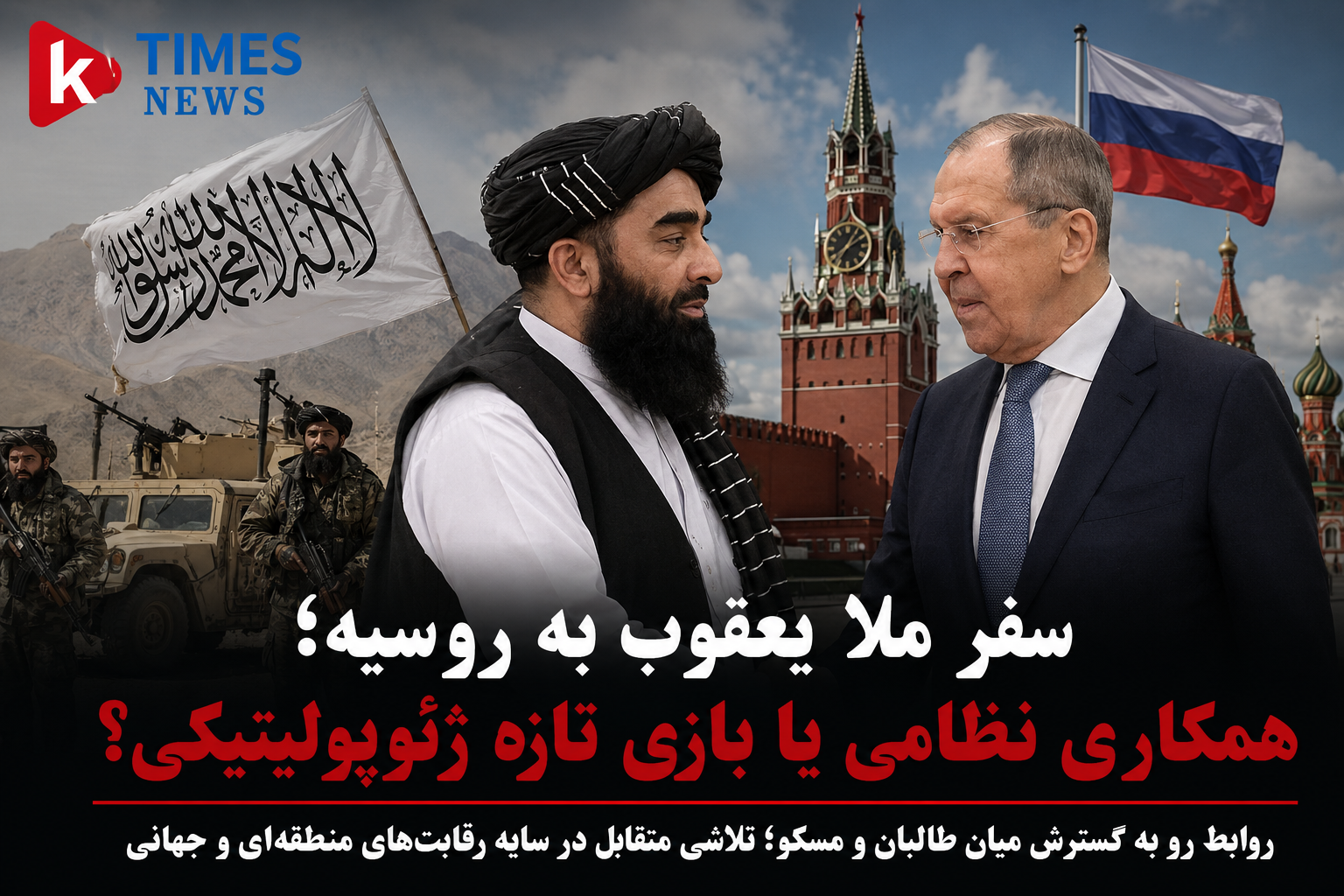
Mullah Yaqub's visit to Russia; Military cooperation or a new geopolitical game?
Analysis | Kabul Times News: Author: Sediqullah Tohidi
The recent visit of Mullah Yaqub, the Taliban's Minister of Defense, to the Russian Federation cannot be considered a mere ceremonial visit or a routine diplomatic event. This visit has taken place in a situation where geopolitical competitions in the region have entered a new phase and global and regional powers are trying to redefine their position in the security equations of Afghanistan.
In the contemporary history of Afghanistan, the Ministry of Defense has always been one of the most sensitive and specialized government institutions. In most political periods of the country, officials of this ministry had a military background, professional training, and command experience in defense structures. However, during the Taliban's rule, ideological and political criteria played a greater role than military expertise in appointing senior security officials.
Mullah Yaqub, the son of Mullah Mohammad Omar, the founder of the Taliban, also reached the position of Minister of Defense in such a context. He lacks classical military training and experience in managing modern defense structures, and his background is more defined in the field of religious education. For this reason, his statements and positions on military issues are always considered with greater care and sensitivity.
One notable example was his words after returning from Russia, when he announced: “From now on, Pakistan will no longer be able to invade Afghan airspace.”
Rather than indicating a definitive strategic shift, these statements raised several questions about the nature of possible agreements between the Taliban and Russia. Has Moscow committed to providing air defense systems to the Taliban? Has an agreement been formed between the two sides beyond educational and technical cooperation? Or were these words simply a reflection of political optimism about the results of the trip?
The Taliban’s subsequent reactions also seem to indicate caution in this regard. After these statements, Taliban spokesman Zabihullah Mujahid emphasized that military cooperation between Kabul and Moscow will not be against any third country; a position that indicates an attempt to reduce regional sensitivities.
Cooperation protocol or defense pact?
A review of the published information shows that what has been discussed between Russia and the Taliban so far is more in the form of a military cooperation protocol than a binding security or defense pact.
In international law, defense pacts are usually concluded between states that enjoy official recognition and full international legitimacy. The Taliban government is still not recognized by most countries in the world, and this issue poses serious legal and political limitations to the conclusion of any official defense pact.
From this perspective, Russia prefers to define its cooperation in the areas of technical, educational, logistical, and reconstruction of equipment left over from the Soviet era; cooperation that is more flexible and creates less political cost for the Kremlin.
Russia’s Goals in Afghanistan
Moscow’s expanding cooperation with the Taliban can be analyzed in the context of several broad geopolitical goals.
First, Russia considers the security of the Central Asian republics and its southern borders to be a strategic priority. Concerns about the activities of extremist groups and the possibility of insecurity spreading from Afghanistan to Central Asia have pushed the Kremlin to engage with the Taliban.
Second, Moscow is trying to exploit the vacuum created by the decline in the West’s direct presence in Afghanistan and increase its influence in the country. However, Russia is not economically and financially capable of completely replacing the extensive Western assistance and cannot play a similar role in the Afghan economy.
Will the balance of power shift?
Despite the expansion of relations between the Taliban and Russia, it seems unrealistic to imagine that this cooperation could fundamentally change the balance of power between the Taliban and Pakistan.
Pakistan still enjoys significant superiority in air power, missile capabilities, military infrastructure, and international security relations. On the other hand, there is no credible indication that Russia intends to transfer advanced air defense systems such as the S-300 or S-400 to the Taliban.
Although the transfer of some military equipment to the Taliban is not necessarily prohibited from legal perspective, the sale of advanced weapons involves complex political, financial, and security considerations that have not yet been realized.
Conclusion
The growing relationship between Russia and the Taliban should be viewed as a mutual effort to exploit each other’s capabilities in the context of regional and global competition, rather than as a strategic alliance or full-fledged defense pact.
The Taliban are seeking legitimacy and expanding their foreign relations, and Russia is also trying to maintain its influence in one of the most important geopolitical points in the region. However, it is still too early to make a definitive judgment on the dimensions and consequences of this cooperation.
What seems certain is that Mullah Yaqoob's visit to Moscow was not simply a diplomatic visit; rather, it is a sign of the formation of a new chapter in Taliban-Russian relations; a chapter whose effects on Afghanistan's future and the security balance of the region will become clearer in the coming months and years.
Mullah Yaqub's visit to Russia; Military cooperation or a new geopolitical game?