To be published in the Kabul Times News, your text needed a journalistic tone, professional structure, analytical coherence, and literary editing. The following version has been prepared as a professional, official, and publishable article:
⸻
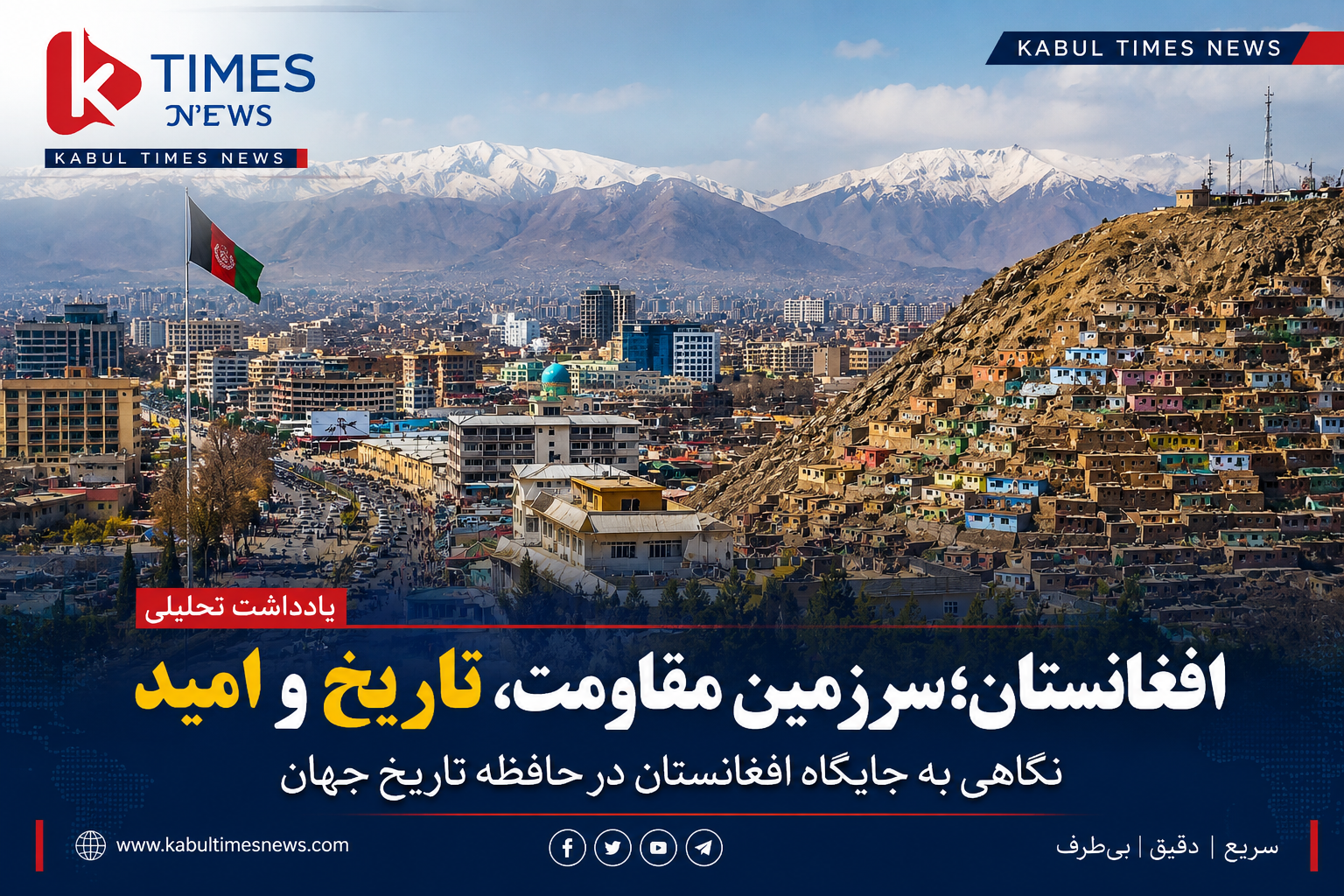
Afghanistan; Land of Resistance, History, and Hope
A Look at Afghanistan’s Place in the Memory of World History
In the memory of history, Afghanistan has not been just a land; it has been a crossroads of civilizations, a graveyard of empires, and a symbol of the perseverance of people who, with minimal resources but with a firm will, have stood up to the greatest powers in the world.
From the soaring mountain ranges of the Hindu Kush to the scorching plains of the south, this land has repeatedly witnessed the campaigns of powers that had conquered a large part of the world, but in Afghanistan they encountered a different reality; a reality called the “spirit of resistance.”
Throughout history, Afghanistan has had a special place in regional and global equations not only because of its geographical location, but also because of the culture of independence of its people. This land is the crossroads of Asia; a point that has always been the meeting point of civilizations, cultures and great powers.
Afghanistan against empires
After crossing half the world, when Alexander the Great reached the land of Ariana and Bactria, he encountered people who considered submission a disgrace. Although he was able to capture some cities, he was never able to break the spirit of freedom-seeking of the people of this land.
Centuries later, Genghis Khan and the Mongol army entered Afghanistan with a wave of destruction and violence. Cities burned and civilizations were damaged, but the flame of resistance and identity of this land was not extinguished.
In the 19th century, the British Empire – on whose territory the sun never sets – experienced a haughty defeat in the mountains of Afghanistan and was forced to retreat from the heart of Asia.
In the 20th century, the Soviet Union entered Afghanistan with a huge army and modern equipment, but was exhausted by the faith, perseverance and resistance of the Afghan people. Many analysts of contemporary history consider the Soviet Union’s defeat in Afghanistan to be one of the important factors in the collapse of that superpower.
And in the 21st century, the United States of America, with the world’s most advanced military technology, left Afghanistan after two decades of military presence and huge expenses; while it had not yet fully understood the historical, cultural and social complexities of this land.
The secret of Afghanistan’s resistance
The secret of Afghanistan’s durability and resistance is not limited to war and weapons. This feature must be sought in the difficult geography, culture of zeal, spirit of independence and deep beliefs of its people.
The mountains of Afghanistan have become natural fortresses throughout history, and the people of this land consider freedom to be part of their identity and human dignity. Afghanistan may have always faced difficulties in terms of economy and resources, but when it came to defending its homeland, this nation had the richest asset: will and courage.
The Great Internal Challenge
Despite these historical glories, the reality of Afghanistan is not just a story of victory over foreigners; it is also a story of deep internal pain.
Afghans have stood like mountains against foreign enemies many times, but internal disputes, ethnic prejudices, political rivalries, and the lack of national unity have always been the most important factors of vulnerability for the country.
History has shown that foreign powers have often used these same gaps to infiltrate and weaken Afghanistan, because there is no threat to a nation more dangerous than internal division.
The Responsibility of Today’s Generation
Today, Afghanistan needs unity, collective wisdom, and national reconstruction more than ever. The new generation must know that honor is not limited to fighting; it also finds meaning in building, in science, in justice, in mutual acceptance, and in transforming the spirit of resistance into a force for national progress.
If Afghanistan has been the defeat field of empires throughout history, it can also become the victory field of rationality, development, and national solidarity in the future.
Afghanistan is still the same proud land; a land whose mountains do not surrender and whose people keep hope alive even in the most difficult days.
History testifies that great powers have come and gone, but Afghanistan, with all its wounds, still stands; because the roots of this land are woven into the freedom-seeking, honor, and invincible spirit of its people.
⸻
Author:
Sayed Nezamuddin Wahdat
Head of the Defenders of the National Interests of Afghanistan
Afghanistan: A land that defeated empires but still seeks unity