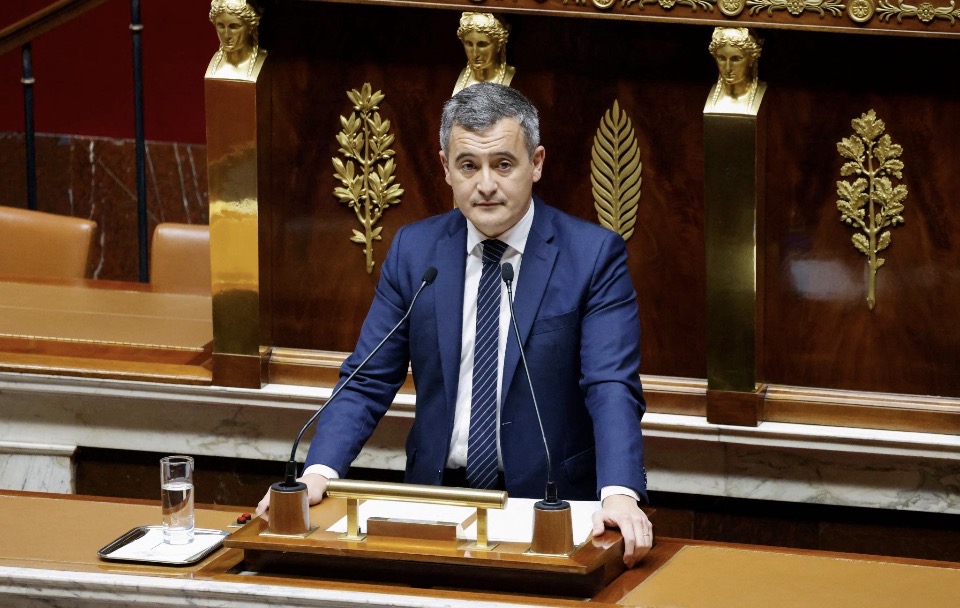
Gérald Darmanin, France’s Minister of Justice, has called for a three-year suspension of immigration to the country, stating that France has reached the “limit of its capacity” in terms of integrating and assimilating migrants.
In his remarks, he said that the French government must adopt stricter immigration policies and significantly reduce the flow of migrants entering the country.
As part of this proposal, Darmanin presented several major measures:
1. Suspending residence permits for family reunification for relatives of individuals who obtained residency through employment.
2. Reforming the French Constitution to allow the introduction of restrictive immigration quotas.
3. Reviewing the number of migrants, their countries of origin, and their qualifications and skills before admission.
4. Tightening the visa issuance process.
5. Making visa issuance conditional on the cooperation of countries in accepting individuals who have received orders to leave French territory.
Statements by the French Justice Minister
Darmanin stated:
“We must stop immigration, expel those who should be expelled, make visa issuance conditional on the acceptance of orders to leave French territory, and focus on the assimilation of those who are already on French soil.”
He emphasized that the current level of immigration is placing heavy pressure on the administrative system, social services, and migrant integration programs.
According to figures from the French Ministry of the Interior, French authorities issued approximately 4.5 million residence permits in 2025, a record-high number in recent years.
The remarks by the French Justice Minister have sparked widespread reactions across political and social circles in France.
Right-wing parties and anti-immigration groups have supported the proposal, describing it as necessary for border control and national security.
Meanwhile, human rights organizations and some left-wing political groups have warned that such policies could increase discrimination against migrants and further restrict the rights of asylum seekers.
Immigration has become one of the most significant political issues in France and across Europe in recent years, with governments attempting to balance economic needs, security concerns, and humanitarian obligations.
So far, Gérald Darmanin’s statements have mainly focused on reducing general immigration, work-related residency permits, and family reunification. He has not specifically stated that political and humanitarian cases would be completely suspended.
However, if such policies are implemented, they could affect many immigration procedures, including:
Asylum applications, humanitarian cases, special residency permits, and some political cases.
At the same time, France and other European countries remain bound by international laws and refugee conventions to examine applications from individuals fleeing war, political persecution, torture, or threats to their lives. For this reason, political asylum and humanitarian cases are generally treated separately from ordinary immigration.
Nevertheless, in practice, the process could become more difficult and lengthy, fewer applications might be accepted, and residency or renewal conditions could become stricter.
As of now, no official law has been adopted in France to completely halt political and humanitarian cases, and the matter currently remains at the level of political debate and proposal.
Controversial Proposal to Halt Immigration to France for Three Years