Introduction
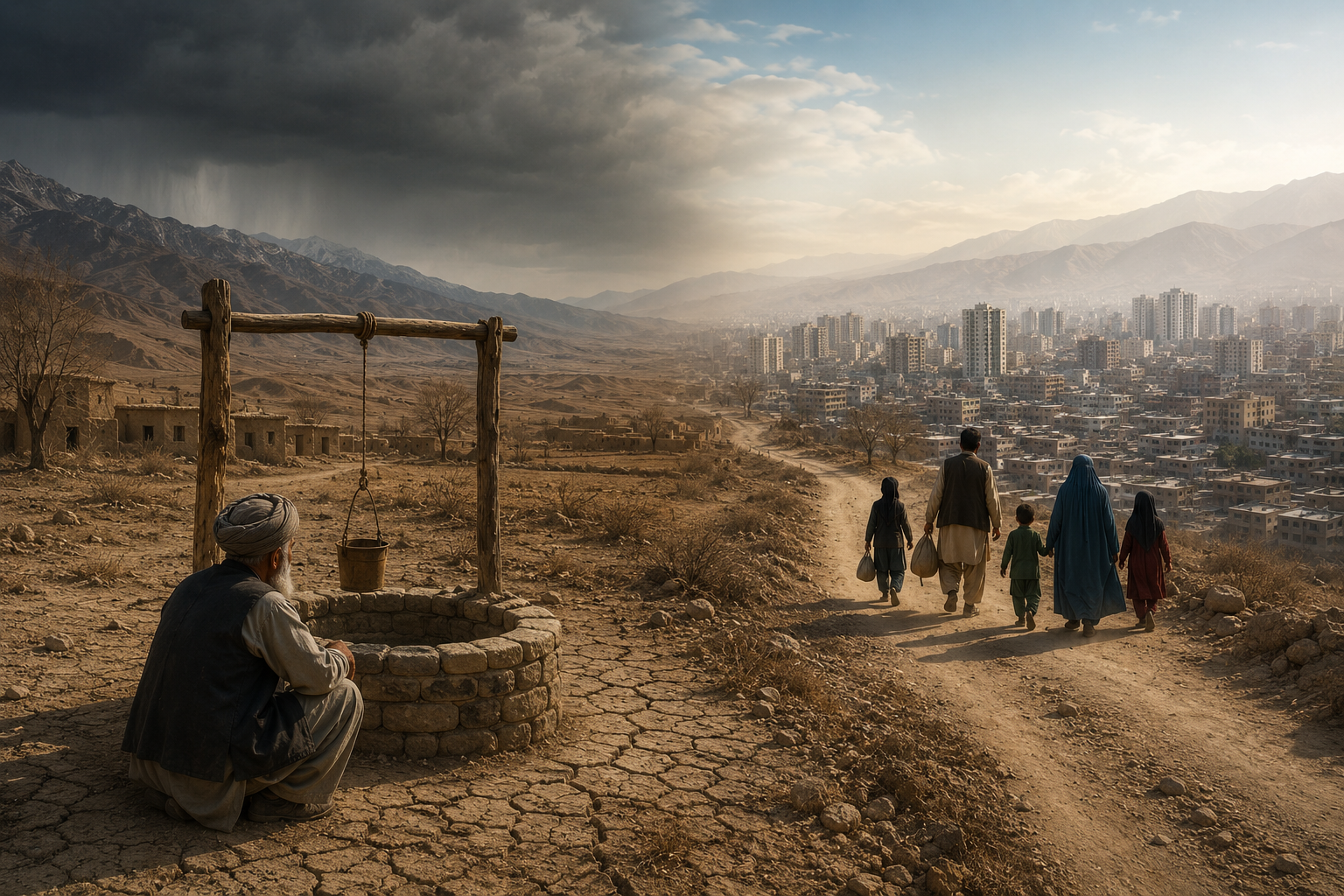
In a village in Herat Province, an elderly farmer who had spent his entire life cultivating the land decided a few years ago to sell his property. It was not war that had reached his village, nor had any armed group forced him from his home. There was no family dispute compelling him to leave.
The reason was much simpler, yet far more profound:
The well that had provided drinking water and irrigation for three generations of his family had run dry.
At first glance, this may seem like a local story—the tale of a water source disappearing in a remote corner of Afghanistan. Yet upon closer reflection, it becomes clear that this story represents one of the most significant challenges facing Afghan society today.
When that well dried up, it was not only water that disappeared.
A family’s livelihood, its connection to the land, its hope for the future, and ultimately part of the social order of an entire village were also transformed.
This is precisely where a common misunderstanding arises. When climate change is discussed, attention is often directed toward natural phenomena: declining rainfall, rising temperatures, sudden floods, recurrent droughts, and expanding desertification. Yet a fundamental question remains: why do these environmental changes generate such profound social and political consequences in Afghanistan?
Why can the drying up of a spring lead to the migration of several families? Why does reduced rainfall in one province eventually manifest itself in growing urban poverty a few years later? And why does a water crisis gradually evolve into a crisis of trust, development, and even governance?
The answers to these questions lead us beyond the realm of environmental studies. In Afghanistan, climate change is no longer merely an environmental issue; it has become one of the most significant tests of society’s and the state’s capacity to govern the country.
For this reason, understanding climate change solely through the lens of nature is insufficient. It must also be examined in relation to the economy, society, migration, resource management, and governance.
This article explores climate change in Afghanistan from four perspectives: the erosion of the rural economy, the expansion of climate-induced migration and social transformation, increasing competition over water resources, and the extent to which public institutions possess the capacity to manage the future. Examining these dimensions reveals that Afghanistan’s principal challenge is not merely water scarcity or rising temperatures. Rather, the central question is whether the country’s social and institutional structures are capable of adapting to new climatic realities.
I. The Erosion of Rural Livelihoods and the Climate Crisis
To understand the consequences of climate change in Afghanistan, one must begin with the countryside. A large proportion of the country’s population still lives in rural areas and depends directly or indirectly on agriculture and livestock. In many regions, land, water, and livestock constitute the only assets available to families.
Consequently, any change in climatic patterns directly affects the foundations of everyday life.
In the past, despite numerous limitations, Afghan farmers possessed a certain degree of predictability. They knew when to plant, when to harvest, and how to manage limited water resources. However, climate change has disrupted this historical rhythm. Rainfall has become increasingly irregular, drought periods have grown longer, and sudden floods have become more frequent.
As a result, agriculture has become a far riskier activity than before.
The problem extends far beyond declining crop yields. When a rural family loses its harvest, a chain reaction of vulnerabilities emerges. Income declines, debt increases, livestock are sold, and the capacity to invest in the next season disappears. Under such conditions, poverty ceases to be a temporary hardship and becomes a persistent cycle.
It is at this point that the distinction between a natural crisis and a governance crisis becomes evident. Drought is a natural phenomenon, but the transformation of drought into widespread poverty depends largely on how societies and institutions respond to it.
In countries where adequate infrastructure, agricultural support systems, resource management mechanisms, and adaptation policies exist, climatic shocks do not necessarily lead to the collapse of livelihoods. In Afghanistan, however, the historical vulnerability of the rural economy has made every climatic shock far more destructive, pushing already fragile communities deeper into hardship.
II. Climate Migration and the Social Crisis
One of the most significant consequences of climate change in Afghanistan is the expansion of both internal and international migration.
Development scholars describe this phenomenon as “climate migration”—the movement of people who are forced to leave their homes not because of war, but because the conditions necessary for sustainable living have disappeared.
This trend is becoming increasingly visible in Afghanistan. Families that can no longer sustain agricultural production migrate to urban areas. Rural households that have lost their livestock seek new opportunities in provincial capitals and major cities.
Although these migrations appear to be economic decisions, they actually reflect a deeper rupture in the relationship between people and their land.
The challenge begins when cities themselves lack the capacity to absorb these newcomers. Kabul, Herat, Mazar-e-Sharif, and other major urban centers have long struggled with population pressure, inadequate infrastructure, limited water resources, and fragile labor markets.
The continuous arrival of new migrants intensifies these pressures.
Consequently, drought in a remote village does not remain confined to that village. Its effects gradually spread to urban areas, manifesting themselves in urban poverty, unemployment, informal settlements, and growing pressure on public services.
This is the moment when climate change becomes a social and political issue.
Climate migration also has deeper implications. Villages that lose their productive population experience declining agricultural output and weakened social capital. Meanwhile, cities unprepared for rapid demographic growth face new social tensions.
Climate change, therefore, is reshaping not only Afghanistan’s physical geography but also its human geography.
III. The Water Crisis and the Crisis of Trust
If one were to identify the most important intersection between climate change and governance in Afghanistan, it would undoubtedly be water.
Water is not merely a natural resource; it forms the backbone of agricultural production, food security, and many aspects of social relations. Yet climate change has placed this vital resource under increasing pressure.
Declining precipitation, rising evaporation rates, changing snowmelt patterns, and prolonged droughts have all made access to water more difficult.
Nevertheless, the primary issue is not simply water scarcity.
Many countries around the world possess fewer water resources than Afghanistan yet do not experience similar crises. The crucial difference lies in resource management.
As water becomes scarcer, competition over access inevitably intensifies. Farmers, villages, and entire regions become increasingly dependent on one another. Under such circumstances, institutions capable of regulating competition and allocating resources fairly become indispensable.
In this sense, Afghanistan’s water crisis is less a crisis of resources than a crisis of resource management.
When clear rules governing water use are absent, when storage and distribution infrastructure remain inadequate, and when long-term planning is replaced by short-term decision-making, water scarcity evolves into a crisis of trust.
From this perspective, water management is no longer merely a technical or engineering issue. It has become central to the relationship between the state and society.
The quality of water governance in the coming years will influence not only food security but also social stability, community resilience, and the legitimacy of public institutions.
IV. Climate Change as a Test of Governance Capacity
Ultimately, all aspects of this discussion lead to a fundamental question:
Is Afghanistan prepared to live under new climatic conditions?
Climate change differs from many other crises. Wars may begin suddenly and end suddenly. Climate change, by contrast, advances gradually. Yet its consequences can be deeper and more enduring.
For this reason, addressing climate change requires long-term thinking, strategic planning, and effective institutions.
Afghanistan’s central challenge lies precisely here. The issue is not simply that rainfall has declined or temperatures have increased. Rather, it concerns the extent to which society and its institutions can adapt to these new realities.
In essence, climate change functions as a test of governance. It evaluates not military strength, but the capacity for planning, coordination, and future-oriented management.
Drought alone does not cause governments to fail. What creates crises is the inability to manage drought’s consequences.
Therefore, any discussion of climate change in Afghanistan inevitably becomes a discussion about governance.
The country’s future will depend less on the amount of rainfall it receives and more on the quality of decision-making, institutional capacity, and adaptability to changing realities.
Conclusion
Perhaps the greatest mistake would be to view climate change solely as an environmental issue.
What is unfolding in Afghanistan today goes beyond changes in weather patterns; it represents a redefinition of the relationship between society and territory.
Nature is changing, but at the same time it is compelling society to adapt to new realities.
The drying up of a well in Ghor, declining harvests in Badghis, the migration of a family to Herat, or water shortages in a remote village are not isolated events. They are interconnected links in a single chain—a chain that begins with climatic change and extends to livelihoods, migration, food security, social cohesion, and governance.
Thus, Afghanistan’s principal challenge in the coming decades will not merely be coping with droughts, floods, or diminishing water resources. The deeper challenge will be establishing a new and sustainable balance among society, the state, and a territory that is itself undergoing transformation.
Climate change not only places pressure on natural resources; it also tests institutional capacity, policy quality, and society’s ability to adapt to the future.
If the twentieth century in Afghanistan was largely defined by the challenge of state-building, one of the defining questions of the twenty-first century will be how to preserve the conditions necessary for living, production, and development under changing climatic conditions.
The answer lies not solely in managing natural resources. It depends equally on the quality of governance, forward-looking policymaking, and the ability to create a sustainable relationship between people and their environment.
Ultimately, Afghanistan’s future will be shaped not only by what happens to its climate, but by how its society and institutions respond to those changes.
Why Climate Change Is Not Merely an Environmental Crisis: Reflections on the Challenge of Governance in Afghanistan by Dawood tanin.Jurnalist