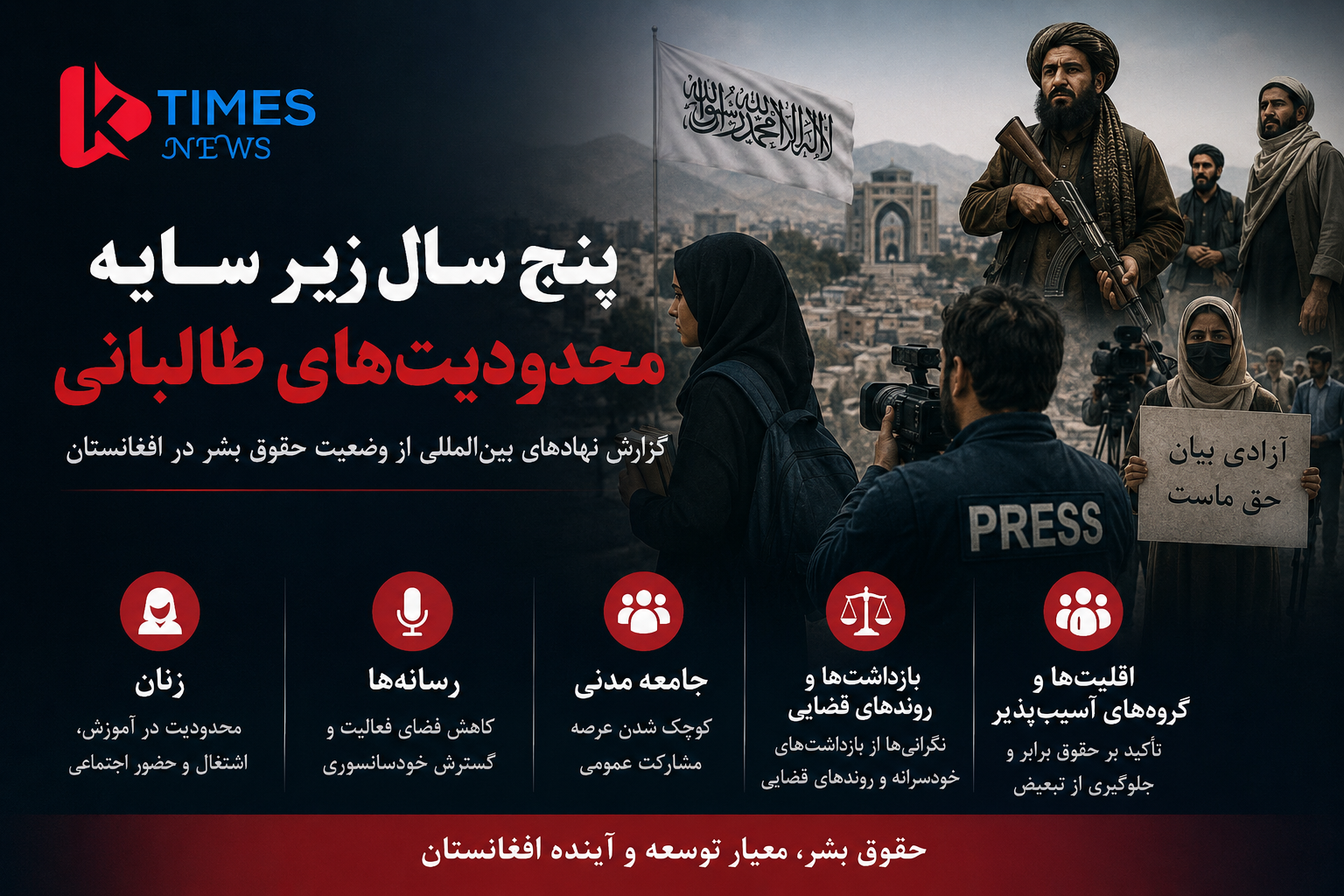
Five Years Under the Shadow of Taliban Restrictions: The Human Rights Outlook in Afghanistan
By Omid Behrouz
Five years after the Taliban’s return to power, Afghanistan finds itself in a situation that international human rights organizations describe as a period marked by the expansion of structural restrictions on fundamental rights and freedoms. Reports published by the United Nations, Human Rights Watch, and Amnesty International over this period point to profound and lasting changes in Afghanistan’s human rights landscape, particularly in the areas of women’s rights, freedom of expression, media activity, and civic space.
The Taliban, however, have repeatedly rejected these reports, describing them as unfair and biased. Nevertheless, the consistency and repetition of such assessments over the past five years have made Afghanistan’s human rights situation one of the most closely watched issues on the international agenda.
Women: Restrictions on Education, Employment, and Social Participation
Restrictions imposed on the education, employment, and social participation of women and girls have remained among the most significant concerns raised by international organizations during this period.
Across large parts of the country, girls have been denied access to secondary and higher education, while women’s participation in many professional, administrative, and social sectors has been severely restricted or halted altogether. International observers view this situation not merely as a social policy, but as a structural transformation affecting women’s access to equal opportunities within Afghan society.
The consequences of these measures—particularly for human development, the education of future generations, and the labor market—are increasingly being viewed as long-term challenges for Afghanistan.
Media: Shrinking Space and Growing Self-Censorship
Afghanistan’s media environment has undergone significant changes over the past five years, including a decline in the number of active media outlets, restrictions on access to information, and increasing pressure on journalistic activities.
Under such conditions, many journalists and media professionals describe self-censorship as a daily reality of their work. This trend has contributed to a reduction in the diversity of viewpoints and a narrowing of the space for public debate.
Civil Society: A Diminishing Sphere of Public Participation
Civil society organizations have also faced operational and structural constraints during this period. Numerous non-governmental organizations have reduced or suspended their activities, while many civil society activists have been forced to leave the country.
As a result, public participation has weakened, and the role of civil society in social oversight, advocacy, and policy dialogue has been significantly diminished.
Arrests and Judicial Processes
International reports have also raised concerns regarding arbitrary detentions and certain judicial practices in Afghanistan.
Taliban authorities reject these allegations; however, the issue continues to feature prominently in international human rights reports and global discussions concerning Afghanistan.
Minorities and Vulnerable Groups
Several reports have further highlighted the situation of religious and ethnic minorities, as well as other vulnerable groups in Afghanistan. These assessments emphasize the importance of guaranteeing equal rights for all citizens and preventing all forms of discrimination.
Conclusion
Overall, the past five years in Afghanistan have been characterized by extensive and persistent restrictions on human rights—restrictions that have gradually expanded across social, civic, and political spheres.
While opinions differ regarding the nature and extent of these developments, international reports indicate that fundamental rights and freedoms in Afghanistan continue to face significant challenges and limitations.
The future trajectory of this situation will largely depend on the nature of engagement between the governing authorities, Afghan society, and international institutions—an interaction that may ultimately shape the course of human rights in Afghanistan in the years ahead.
Five Years Under the Shadow of Taliban Restrictions: The Human Rights Outlook in Afghanistan