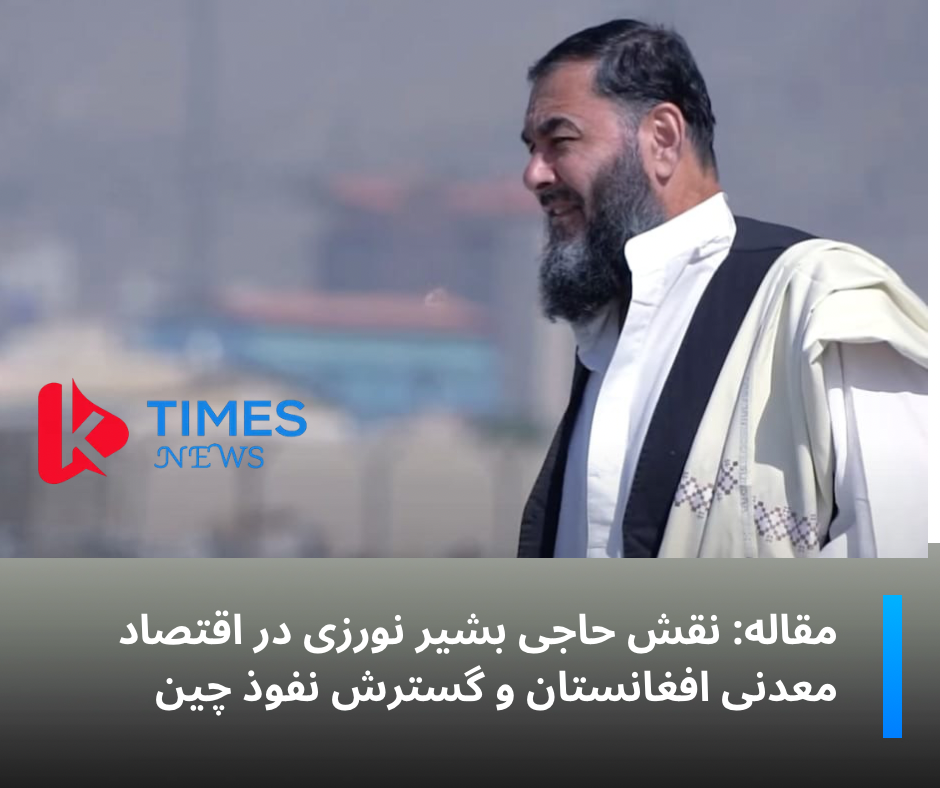
The Role of Haji Bashir Noorzai in Afghanistan's Mining Economy and the Expansion of China's Influence
Article | Author: Shahpour Naibzada
Haji Bashir Noorzai, who was known for years as one of Afghanistan's biggest drug traffickers and was nicknamed "Afghanistan's Pablo Escobar" by some international media outlets, has now become one of the influential figures in economic cooperation between the Taliban and China after his release from a US prison.
Noorzai, who was once serving a life sentence in the US, was released in September 2022 as part of a prisoner exchange agreement between Washington and the Taliban in exchange for the release of American contractor Mark Frericks. Since then, various reports have indicated his prominent role in Afghanistan's mining and energy contracts.
According to informed sources in the Afghan mining and security sector, companies affiliated with Noorzai have succeeded in signing several contracts in the fields of mining and energy resources with the participation of Chinese companies. Critics believe that these contracts have created rentier networks and concentrated wealth in the hands of Taliban circles rather than helping Afghanistan’s economic development.
Haji Bashir Noorzai, who was considered one of the main players in Afghanistan’s heroin trade before his arrest, is reported to have close ties to senior Taliban leaders, including Haibatullah Akhundzada, the group’s leader. Some sources also say he has close ties to Amir Khan Muttaqi, the Taliban’s foreign minister.
According to an informed source who asked not to be named, Noorzai’s company also holds a license to conduct exploratory studies of hydrocarbon resources in the Amu Darya basin, on Afghanistan’s border with Uzbekistan and Tajikistan. The source claims that Noorzai’s influence in the Taliban power structure is the result of his extensive financial support for the group during the years of war.
China, the Taliban, and Afghanistan’s Mines
As the Taliban seeks to secure financial resources and international legitimacy, China has also increased its investment in Afghanistan’s mining sector. The vast reserves of lithium, copper, iron, gold, coal, and other strategic minerals have made Afghanistan a key target of Beijing’s economic policy.
For the Taliban, mining contracts with Chinese companies, in addition to generating foreign exchange earnings, are an opportunity to break political isolation and attract foreign capital. In return, China, by taking advantage of these partnerships, is strengthening its position in the Belt and Road Initiative and turning Afghanistan into an important link in the path of connecting Central Asia to regional and global markets.
Security cooperation between Beijing and the Taliban
China’s motivation for getting close to the Taliban is not simply economic. Various reports indicate the expansion of security cooperation between the two sides. Beijing is said to have provided the Taliban with surveillance equipment and security technologies so that the group can better control its domestic opponents.
In contrast, China has sought to curb the activities of members of the East Turkestan Islamic Movement, a group that Beijing sees as a threat to its national security and believes has members in Afghanistan.
Despite this cooperation, China’s security concerns remain. In recent years, Chinese citizens and economic interests in Afghanistan and Pakistan have repeatedly been targeted by armed groups, suggesting that close ties with the Taliban do not necessarily guarantee the security of Chinese investments.
Is corruption returning to the mining sector?
Bashir Noorzai’s return to the economic arena, this time in the form of mining projects, has once again raised questions about the transparency of contracts for extracting Afghanistan’s natural resources.
Afghanistan has long been touted as a potential engine for economic development, but war, insecurity, structural corruption, weak infrastructure, and a lack of a transparent resource management system have hindered the sustainable exploitation of these capacities.
Experts believe that while mining contracts can generate significant revenue for the government, in the absence of independent oversight, financial transparency, and accountability, these resources may serve to consolidate the power of political and economic groups rather than contribute to the well-being of the Afghan people.
Conclusion
Afghanistan today is at the intersection of the interests of regional powers. China seeks to secure investments and access to strategic resources, and the Taliban also needs this cooperation to secure financial resources and gain political legitimacy.
Meanwhile, figures such as Haji Bashir Noorzai, who has a long history in the informal economy and close ties to the Taliban, have become key players in this equation.
However, the fundamental question remains: Will the exploitation of Afghanistan’s vast mineral resources ultimately lead to the development and well-being of the country’s people, or will its benefits, as in the past, be channeled to narrow power networks and foreign actors?
The Role of Haji Bashir Noorzai in Afghanistan's Mining Economy and the Expansion of China's Influence