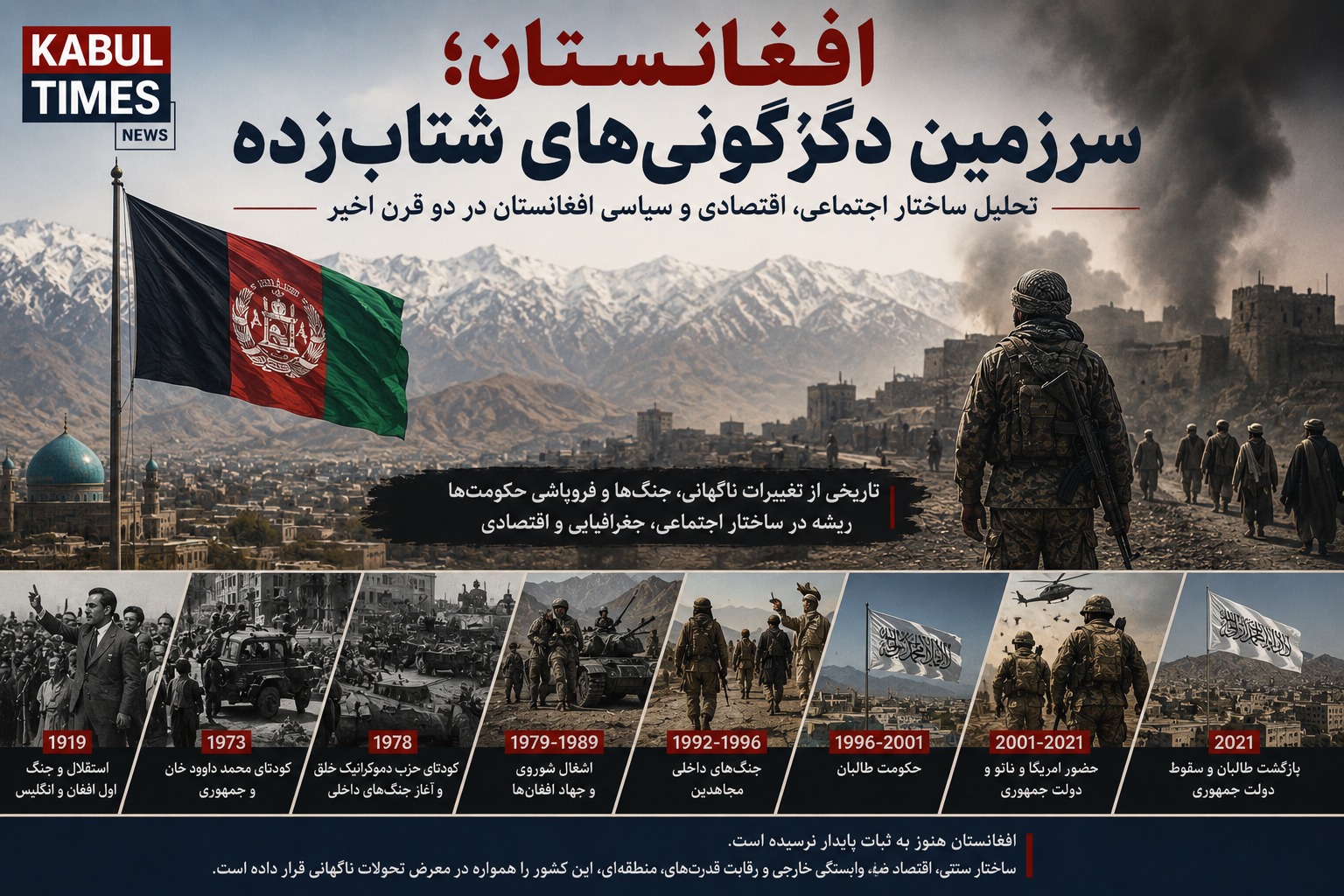
Afghanistan; A Land of Rapid Transformation
Why is Afghanistan Always Prone to Collapse and Sudden Changes?
Exclusive | For Kabul Times News
Afghanistan has been one of the most rapidly changing countries in the region over the past two centuries; a country where coups, civil wars, foreign occupations, and the collapse of governments have occurred repeatedly and with unexpected speed. Analysts believe that this situation is rooted in Afghanistan’s unique social, geographical, and economic structure.
A review of contemporary history shows that, except for the relatively peaceful period of the reign of Mohammad Zahir Shah, Afghanistan has almost always faced political crisis and instability. Various governments in this country have often failed to establish lasting and nationwide authority.
Experts consider Afghanistan’s decentralized social structure to be one of the most important factors in this instability. While in many countries modern political and economic institutions form the foundations of stability, in Afghanistan ethnic, tribal, and religious ties have often been more powerful than the central government.
Afghanistan's mountainous geography has also historically allowed opposition groups to wage long and attritional wars. From the Afghan-British wars to the resistance against the Soviet Union and then the Taliban wars, geography has always played a decisive role in the country's political and military developments.
In addition to these factors, the weak economy and heavy dependence on foreign aid have also caused the fragility of the state structure. Poverty, unemployment, and the lack of economic infrastructure have provided the basis for the rapid recruitment of forces into armed and political movements.
The rapid collapse of the government of the Republic of Afghanistan in 2021 and the return of the Taliban were a clear example of this fragility. Despite two decades of Western presence and billions of dollars spent on state-building, the political structure of Afghanistan collapsed in a short time.
Analysts believe that Afghanistan has not yet achieved lasting stability and is still subject to sudden changes. The country's geopolitical position and the competition between regional and global powers have also contributed to the complexity of the crises.
Afghanistan is a country where “apparent stability” can sometimes turn into political collapse in a short period of time; a reality whose roots must be sought in the social, economic, and geographical structure of the country.
⸻
Syed Nizamuddin Wahdat
Head of the Defenders of National Interests of Afghanistan
Afghanistan; A Land of Rapid Transformation